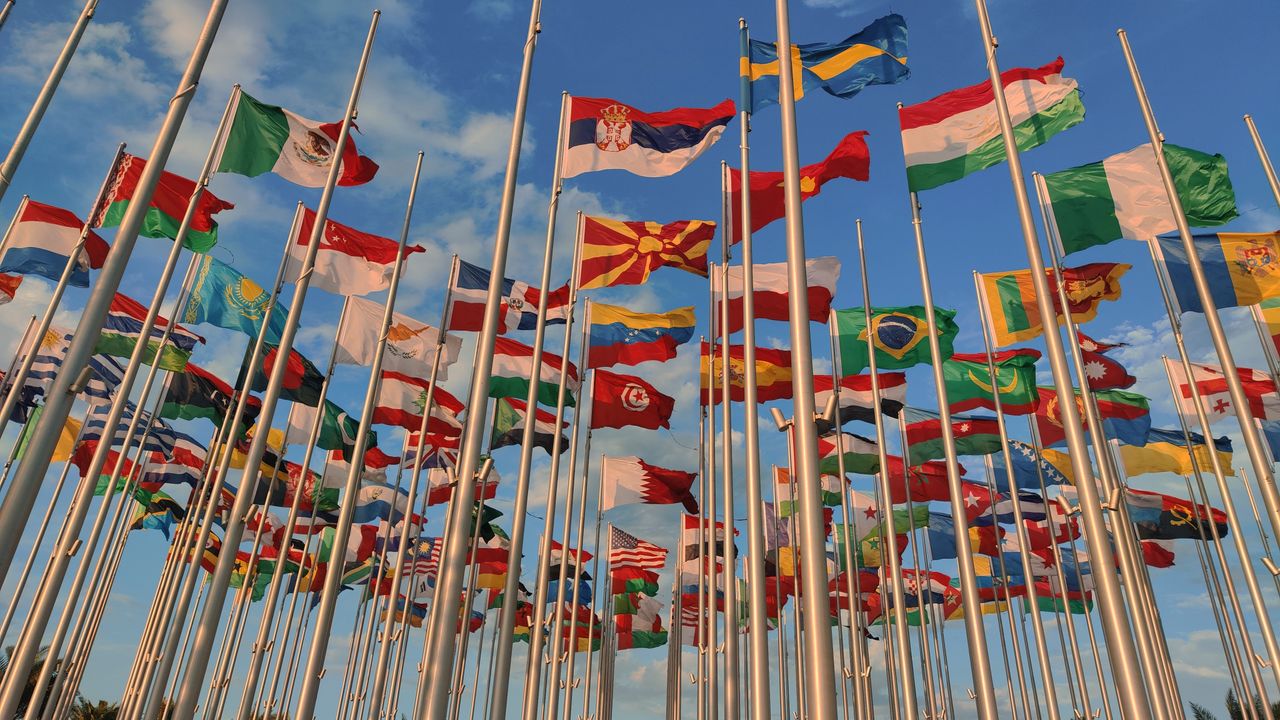
There are 197 flags in this site's flag games: the 193 UN members plus Vatican City, Palestine, Kosovo and Taiwan. Many people start learning them from an alphabetical list, and that is the trouble. A to Z puts Chad next to Chile and far from Romania, so the flags you are most likely to confuse never meet.
How to memorize flags in six steps
1. Learn one region at a time
Neighbours often share colours and ideas, so a region gives you a small set of flags that hang together, and a map to hang them on. Start with the region you half know already, so the first week builds confidence.
Europe Flag Quiz holds 51 European flags, counting the countries that span Europe and Asia, and has no limit on rounds. After a wrong guess it tells you how far away the right country is and which way to look, so you learn where each flag belongs as well. For other continents, open Paint the Flag's country picker, choose a continent and work through its flags one by one.
2. Learn the families before the single flags
Many flags belong to a family that shares colours on purpose. Learn the family once and you have the outline of a dozen flags; after that you only need the detail that sets each one apart.
- Nordic cross: Denmark, Norway, Sweden, Finland and Iceland, each with a cross set towards the flagpole.
- Green, yellow and red: Ghana, Senegal, Mali, Guinea, Cameroon and many more in Africa, after the flag of Ethiopia.
- Red, white, black and green: the Arab flags, such as Egypt, Iraq, Jordan, Kuwait and the UAE.
- White, blue and red: Russia and several other Slavic countries, including Serbia, Slovakia and Slovenia.
- The Union Jack in the corner: Australia, New Zealand, Fiji and Tuvalu.
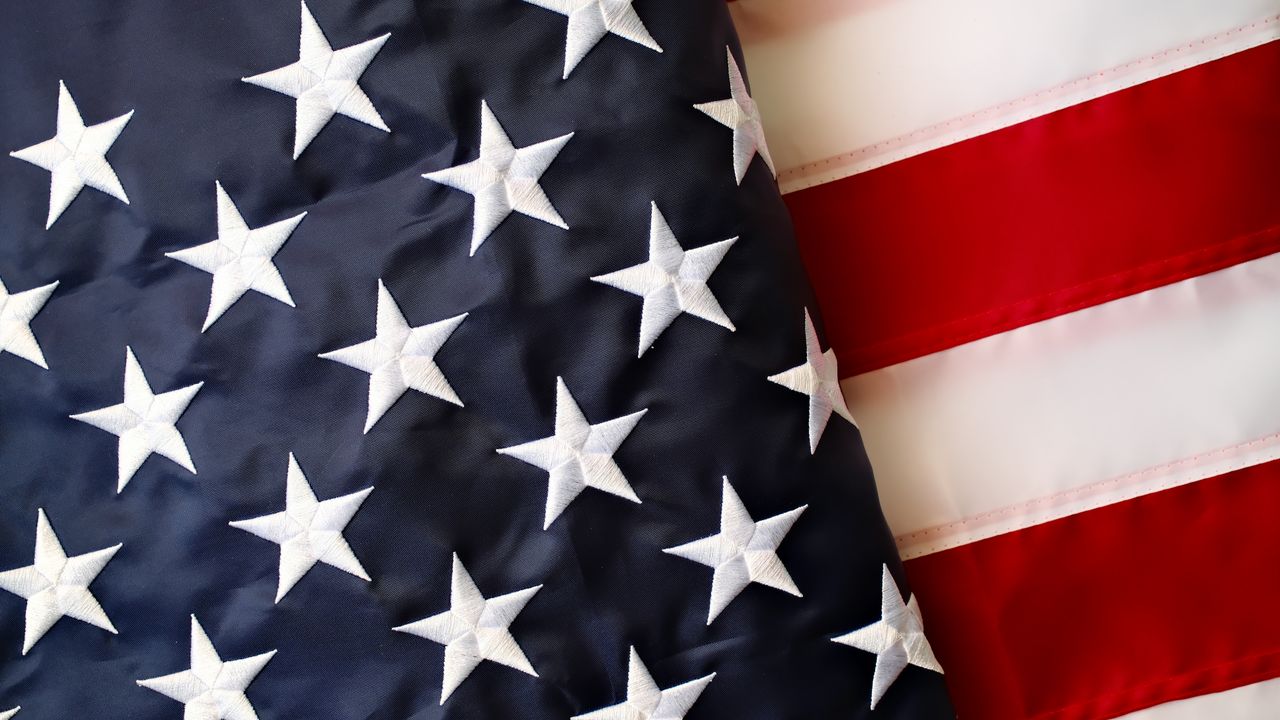
Then give the loners a hook. The US has 50 stars, one for each state. Liberia has 11 stripes, for the 11 men who signed its declaration of independence. Mozambique's flag carries a book, a hoe and an assault rifle. Cyprus and Kosovo put a map of the country on theirs, and Nepal's flag is two pennants, not a rectangle.
Practise with Guess the Flag in unlimited mode. You type a country for each flag, and a wrong guess shows how far off you were. Many families are regional, so a guess from the right family often lands close.
3. Drill the look-alike pairs together
Some flags are so close that you have to learn them as a pair: Chad and Romania (only the blue differs), Indonesia and Monaco (mainly the proportions), Ireland and Ivory Coast (the same colours in mirror order). Put the two side by side and say the difference out loud, so you learn the difference and not two separate flags. The full list is in flags that look alike.
Flag Rush is the game for this step. You pick the country from four names against a clock that shrinks from 5 seconds to 1.5, and as a run goes on it mixes in more and more look-alikes, such as Ireland and Italy, Romania and Moldova, or Senegal and Mali. The near-identical pairs above, Chad and Romania or Indonesia and Monaco, never share a question, so learn those side by side from the list.
4. Test yourself instead of rereading
Rereading a list feels like learning, but tests work better. In a 2006 study by Henry Roediger and Jeffrey Karpicke, students who took recall tests on a text remembered more of it two days and a week later than students who spent the same turns rereading it, even though the rereaders felt more confident. A 2013 review of ten study methods, led by John Dunlosky, rated practice testing and spaced practice the two most useful, and rereading among the least.
So start testing before you feel ready, and treat each miss as the thing to study next. A friend makes the test harder to skip: Flag Battle 1v1 is a real-time race to name flags, usually first to five (the host can set any target from 1 to 20).
5. Paint flags from memory
Picking a name from a list only asks whether you recognise a flag. Drawing it asks you to produce it, which is harder and shows exactly which stripe you had in the wrong order. That is the gap between knowing Mali and Guinea are green, yellow and red and knowing which colour touches the flagpole.
Paint the Flag gives you a blank flag split into areas and the name of the country. You fill in the colours, then see how much of your flag matches the real one.
6. Come back for a few minutes every day
Spread the practice out. The same 2013 review rated spaced practice, study spread over days instead of crammed into one sitting, as highly as practice testing.
The dailies give you a reason to come back. Guess the Flag has one flag a day, the same for everyone, and works through all 197 in a shuffled order. Paint the Flag has a daily flag to paint as well.
How to memorize European flags
Most European flags fall into four shapes. Sort a flag into its shape first, then find the detail.
- Nordic crosses: Denmark (red and white), Norway (red, with a blue cross edged in white), Sweden (blue and yellow), Finland (white, with a blue cross) and Iceland (blue, with a red cross edged in white).
- Upright stripes: France, Italy, Ireland, Belgium, and the blue, yellow and red of Romania, Moldova and Andorra.
- Flat stripes: Germany, Austria, Hungary, Bulgaria, Lithuania, Estonia, Latvia, the Netherlands, Luxembourg and Russia, plus the two-colour flags of Poland, Ukraine and Monaco.
- A shield or emblem: Spain, Portugal, Slovakia, Slovenia, Serbia, Croatia, Montenegro and Albania.
The traps are the near twins inside a shape: the Netherlands and Luxembourg, Slovakia and Slovenia, Austria and Latvia. Practise on the Europe Flag Quiz until those stop catching you.
How to memorize African flags
African flags look like a lot to learn, but many of them fall into a few colour groups.
- Green, yellow and red, the colours of Ethiopia's flag: Ghana, Senegal, Mali, Guinea, Cameroon, Benin, Burkina Faso, Togo, Guinea-Bissau and others. Learn the order of the colours and where the star sits.
- Red, black and green: Kenya, Malawi and South Sudan.
- Arab colours and crescents in the north: Egypt uses red, white and black, and Sudan adds a green triangle; Algeria, Tunisia, Libya and Mauritania carry a crescent and star.
- The rest stand alone, and are easiest to learn by their hook, such as the book, hoe and rifle of Mozambique.
There is no Africa-only flag quiz on the site, so use the Africa tab of Paint the Flag's country picker, then mix them back in with Guess the Flag.
A four-week plan
This is a suggested pace at about 15 minutes a day, not a promise. Slow down if your tests keep showing the same gaps.
Week four adds nothing new on purpose: it is steps 4 and 6, testing and spacing, applied to everything at once. Keep testing across every region until the same flags stop coming up wrong, then keep a daily flag going to hold on to them.
Ready for your first test?
Guess the Flag gives you one flag a day, with distance and direction hints after each wrong guess, plus unlimited play.
Play Guess the FlagQuestions people ask
How long does it take to memorize all the flags?
It depends on how many you know already. The plan on this page covers new flags in three weeks and spends a fourth on review, at about 15 minutes a day. After that, a daily flag or two keeps them fresh.
What is the fastest way to learn flags?
Test yourself instead of rereading, in short sessions spread over days. A 2013 review of ten study methods rated practice testing and spaced practice the most useful, and rereading among the least.
How many flags are there to learn?
Which flags are hardest to tell apart?
Sources
- United Nations: Member States
- United Nations: Non-member States (Holy See, State of Palestine)
- Roediger and Karpicke (2006): Test-Enhanced Learning, Psychological Science
- Dunlosky and others (2013): Improving Students' Learning With Effective Learning Techniques
- Britannica: flag of the United States
- Britannica: flag of Liberia
- Britannica: flag of Mozambique
- Britannica: flag of Cyprus
- Britannica: flag of Kosovo
- Britannica: flag of Nepal
- Wikipedia: Nordic cross flag
- Wikipedia: Pan-Slavic colors
- Britannica: flag of Australia
- Britannica: flag of New Zealand
- Wikipedia: Flag of Fiji
- Wikipedia: Flag of Tuvalu
- Wikipedia: Flag of Sudan
- Wikipedia: Pan-African colours
- Wikipedia: Pan-Arab colors